Your Miracle May Cost You Everything
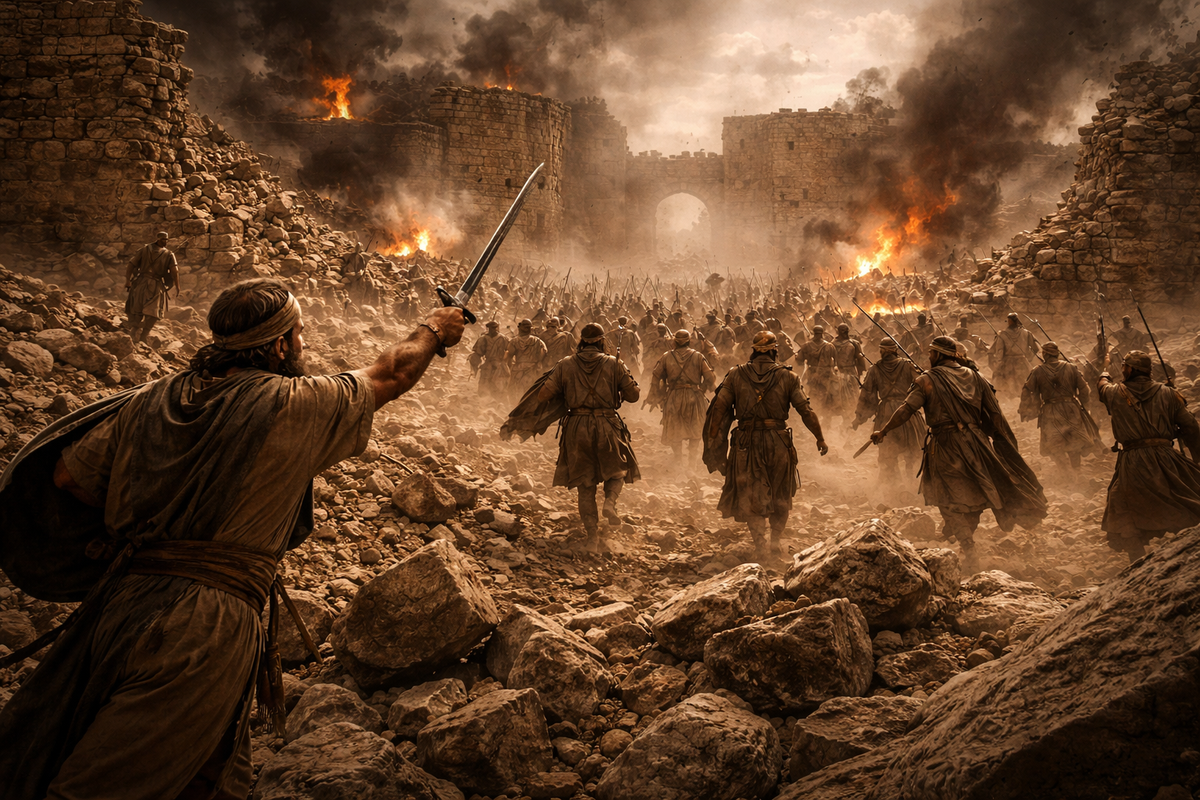
Some of the men who marched around Jericho had no idea what awaited them on the other side of those walls.
We don’t talk about that though. We talk about the shouting, the walls, the faith required to walk silently for seven days as a fortified city looked on. We teach Jericho as a victory story.
And it is.
But the victory wasn’t the walls falling. They were just the beginning.
God told Joshua, “I have given Jericho into your hand” (Joshua 6:2). Past tense. Before the marching. Before the trumpets. Before a single stone shifted.
In God’s economy, it was already done.
Then came the instructions. March. Be silent. Wait. March again. Seven days of this. And then the shout, and the walls came down. And the story was over.
Except it wasn’t.
Joshua 6:20-21 keeps going. The walls fell, and then Israel went into the city. They fought. They took it by force. The supernatural part, the part we build sermon series around, the part that shows up on worship flags and church bulletins, that part was the preamble. The actual war started when the rubble settled and they charged into a city full of people who didn’t want them there.
The miracle didn’t finish the job. The miracle gave them access to the fight they were always supposed to have.
* * *
We’ve been reading this wrong. Or at the very least, stopping too early.
We treat the miracle as the climax. God shows up, the obstacle falls, the story resolves. Go home. Celebrate. Post a testimony on Instagram. But in the text, the miracle is the door, not the destination. What’s on the other side of the door still has teeth.
And this isn’t just Jericho. It’s the whole conquest narrative. God promised the land. The spies went in and came back with a report. Yes, it’s everything God said it would be. Milk and honey. Abundant. Good. Oh, and also, there are giants. Fortified cities. And armies.
The land being promised and the land being occupied by hostile forces were never contradictory. Both were true at the same time. The promise didn’t mean the absence of opposition. It meant the presence of God in the midst of the opposition.
God’s best came packaged with war.
* * *
This matters because of what we’ve done to prophetic culture.
We’ve turned prophecy into a comfort delivery system. People come to a service, or a conference, or a prayer line, and they’re waiting. Waiting for a word. Waiting on God to say the thing that makes their situation better.
And when the word comes, the expectation is that the matter is resolved. God spoke and now the hard part is over.
But with Jericho as our template, the prophetic word is not resolution. It’s deployment orders. The word doesn’t tell you what God is going to do for you. It tells you where God is sending you to fight.
We’ve been treating field orders like greeting cards.
A word from God isn’t safe. It isn’t necessarily even good news. It’s a summons. And a summons comes with a price tag.
* * *
Here’s where it gets hard.
God opened the door at Jericho and Israel walked through with God on their side. But the fight wasn’t over. It was only beginning. The conquest of Canaan stretched on for years. City after city. Campaign after campaign. And the land God promised remained full of hostile forces for generations.
At Ai, the very next battle after Jericho, 36 Israelites died (Joshua 7:5). The miracle at Jericho didn’t insulate them from what came next. One act of disobedience, and the cost became real overnight. The door God opened led to a road that demanded everything they had.
The promise was to the nation. Not to each individual who served the promise.
Which means your obedience to a prophetic word might cost you something.
It might cost you everything.
And the promise of God might still be fulfilled, just not for you. At least not in the way you are expecting. Your faithfulness might be the thing that gets spent so someone else can walk into what God said.
* * *
Moses knew this. Or rather, Moses lived it.
Forty years. That’s what he gave. He led a nation out of slavery, across a sea, through a desert, right to the edge of everything God had promised. And God told him he wouldn’t cross over.
Not because of noble sacrifice. Because of Meribah. Because he struck the rock when he was commanded to speak to it. One failure, forty years in, and the finish line moved beyond his grasp.
The promise remained. Joshua led them across. The land was taken. Everything God said came true. Moses just watched it from the mountain, and then he died.
The exclusion wasn’t even clean. It wasn’t martyrdom. It was consequence. And the promise of God survived both his faithfulness, and his failure.
Because the promise was never about Moses. It was God’s promise. Moses was serving it. He was never owning it.
* * *
There are three versions of this in the text, and none of them are comfortable.
Some people pay the cost through obedience. The generations who fought for the Promised Land, campaign after campaign, year after year, taking ground they wouldn’t live to settle. The promise fulfilled. Their names unrecorded.
Some people pay it through failure. Moses. Forty years of faithfulness undone by a single moment, watching from a distance as someone else finishes what he started.
Some people pay it through both. A lifetime of serving a promise that was always bigger than they were, absorbing both the cost of faithfulness and the consequences of their own sin, and the promise outliving it all.
The apostles lived both. Peter denied Jesus. Thomas doubted. They all scattered at the arrest. And then they came back, served faithfully, and were killed for it.
So the Gospel could reach us.
Faithfulness and failure weren’t sequential phases. They were woven through the same lives.
In every case, the promise is completed. It doesn’t need your success. It doesn’t even need your survival. The promise belongs to God and He will fulfill it. And you might be the seed that goes into the ground so someone else can reap.
* * *
Jesus is the fullest version of this.
The promise to humanity, redemption, reconciliation, the thing every prophet pointed toward, required someone to pay for it with everything. The miracle of the resurrection didn’t come for free.
It came through the cross.
The door we all walk through costs someone everything to open.
And He knew. That’s the part of Gethsemane we skip past. “If it is possible, let this cup pass from Me.” He knew the cost. He asked for another way. There wasn’t one. The promise required the sacrifice.
* * *
What do we do with this now?
Stop expecting the prophetic word to be the end of struggle. Start expecting it to be the beginning.
Hold the promises of God with open hands, understanding that fulfillment might look like nothing we ever imagined. Our role in the story might be the march, not the milk and honey. Our miracle might be the door we walk through but never return from.
We decide if faithfulness to God is worth it. Even if it means we are the one who gets spent.
Because the biblical story, from Jericho to Calvary, keeps saying the same thing. The promise is real. The promise is true.
But someone has to pay for it.
The miracle is the door. What’s on the other side will cost something. Probably everything.
Walk through it anyway.
- Winston Churchill