There is No Self in Self-Control
Peter drew a sword on an armed detachment.
It wasn't a symbolic gesture. He swung at a man's head in the dark, surrounded by soldiers, badly outnumbered. And swung hard enough to remove the man's ear. Whatever you want to say about Peter in the garden, you can't say he was afraid.
And then, just a few hours later, he was standing at a fire in a courtyard telling a servant girl he had never met Jesus.
We usually file that under weakness. Peter got scared, he was impulsive, his faith was shallow and it cracked under pressure.
But look at what he actually had that night. Courage, resolve, a public vow, a weapon, and a stated willingness to die. He told Jesus to His face, "I will lay down my life for Your sake." Nobody in the Gospels tries harder than Peter tries.
Every single input the willpower model requires, he had it at maximum.
And it bought him three denials, and a rooster.
You keep losing to something. You've named it in prayer more times than you can count. You've built systems around it. Accountability partners, apps on your phone, verses taped to the mirror, even fasts that you took very seriously.
And every time it collapses you arrive at the same conclusion:
I need more self-control.
So you rebuild the system. This time you make it tighter, and it holds a little longer. And then as every time before, it fails again. And you start the process over, looking for the flaw in your discipline.
I'd like to suggest that it was never the discipline, and that the phrase you keep reaching for was mistranslated into your hands.
In the Greek it's enkrateia, and it shows up in Galatians 5:23 among the fruit of the Spirit. Then it appears again in 2 Peter 1:6 in Peter's own list.
There is no "self" in it.
It's en, meaning in, plus kratos, meaning strength, power, or dominion. Something like "in-power." Power held within a person. The word locates the strength inside you, and says nothing about where the strength came from.
The King James doesn't even translate the word as ‘self-control’. Instead, it reads "temperance," in both places. "Self-control" is a modern artifact that affects how everyone hears that word.
So a translator supplied a syllable, and the church built a doctrine around it.
Now chase kratos on its own, because Paul does not use it lightly. Ephesians 1:19, the working of His mighty power that raised Christ from the dead. Ephesians 6:10, be strong in the Lord and in the power of His might. Colossians 1:11, strengthened with all might according to His glorious power.
That word is normally reserved for God. That's resurrection vocabulary. And it's sitting inside the one virtue everybody assumes is their own.
Here's the part that makes this deliberate and not accidental.
Enkrateia was not a word Paul invented. It had a long career in Greek philosophy before he touched it, and it meant exactly what you think it means. Self-mastery. The rational man governing his own appetites by force of will. Socrates used it. The Stoics built a program around it. It was the flagship virtue of the ancient world's self-improvement industry.
Paul took that word, the one every educated reader associated with personal achievement, and filed it under karpos.
Fruit. The thing a tree produces because of what it is, because of its intrinsic nature.
He didn't argue that mastery is the wrong goal, but he relocated the source.
And notice the noun is singular. Love, joy, peace, longsuffering, gentleness, goodness, faith, meekness, temperance. Nine words, but one fruit. Not nine projects on your list, one fruit the Spirit is producing in you that shows up in nine different places.
If temperance could be produced by sheer willpower, Romans 7 would not exist.
"For what I am doing, I do not understand. For what I will to do, that I do not practice; but what I hate, that I do." (Romans 7:15, NKJV)
Look at what Paul says about himself. He wants the good. He calls the law holy and just and good. He says he delights in the law of God in the inner man.
Everything the theory needs is present and running full speed.
And verse 18 gives the entire diagnosis in a single line: "for to will is present with me, but how to perform what is good I do not find."
The will is not the problem, it's not the missing piece. The thing that's missing is the supply line.
Watch where he goes next for the answer. He does not close chapter 7 with a technique. No schedule, no discipline, no method. He asks who shall deliver him, then thanks God through Jesus Christ, and the answer lands in the next chapter: the law of the Spirit of life in Christ Jesus made him free.
A person. Not a program.
Regardless of who the "I" is in that chapter, every reading has the same diagnosis. Full willingness, no capacity. You recognize the man because you've been the man.
Peter had already lived it in a courtyard. And Paul now wrote it down.
Paul says it outright to the Galatians, and it stings more because it's a question:
"Are you so foolish? Having begun in the Spirit, are you now being made perfect by the flesh?" (Galatians 3:3, NKJV)
The question isn't if they are trying hard enough, it's why did they switch the source of their power part way through.
That's the failure. Not weak effort. Wrong supply.
And this brings us back to Peter who wrote this many years later:
"And beside this, giving all diligence, add to your faith virtue; and to virtue knowledge; And to knowledge temperance; and to temperance patience; and to patience godliness; And to godliness brotherly kindness; and to brotherly kindness charity." (2 Peter 1:5-7, KJV)
Almost everyone reads that as a staircase. Get faith solid, then work on virtue, then knowledge, then grind out temperance. And this is where most of us stall permanently, because that rung keeps snapping under our own weight.
Read in that way it becomes a performance review, and it will bury you.
Peter opens this passage by pointing backward, and what he's pointing at comes just a couple verses earlier.
"as His divine power hath given unto us all things that pertain unto life and godliness" (v3). And "ye might be partakers of the divine nature" (v4)
Given. Already. Partakers, already. The command in verse 5 is addressed only to people handed a new nature in verse 4. Peter never aims this list at anyone standing outside of that.
The nature comes first. The list is what unpacking it looks like.
And the verb everyone treats as the command, isn't the command. "Giving all diligence" is a participle, something you bring with you into the action. The imperative is epichorēgēsate. Supply.
That word comes from the chorēgos, the wealthy patron in a Greek city who funded a festival chorus out of his own pocket. Costumes, training, the whole production. All paid from someone else's account.
Peter uses the same root six verses later in verse 11, for what God supplies to you. An entrance into the everlasting kingdom.
"for so an entrance will be supplied to you abundantly into the everlasting kingdom of our Lord and Savior Jesus Christ." (2 Peter 1:11, NKJV)
Same word, both directions. God funds you. You fund the chorus.
Now, before this turns into an excuse, let's deal with the obvious objection.
Paul trains. In 1 Corinthians 9:25 he uses the verb form of this same word for an athlete in strict training, and a couple of verses later he says he beats his body and brings it into subjection. That is not the vocabulary of a man waiting passively for fruit to appear.
But look at how he set that chapter up. Necessity is laid upon him. A stewardship was committed to him. He is running under someone else's commission with someone else's power, and the running is real. And it costs him.
An apple tree doesn't strain. But it's also not idle. Sap moves. The flower sets. Sugar gets pushed out to the fruit through an enormous amount of work, and not one bit of it was decided. The tree never woke up and committed to a fruit-bearing regimen.
The tree is doing what it was made to do.
Romans 7 is what it feels like to be a branch trying to run on its own sap.
So the question stops being: "how do I get better at temperance?" and becomes: "how does my nature change?"
Paul answers that, conveniently enough, with a tree.
"And if some of the branches were broken off, and you, being a wild olive tree, were grafted in among them, and with them became a partaker of the root and fatness of the olive tree, do not boast against the branches. But if you do boast, remember that you do not support the root, but the root supports you." (Romans 11:17-18, NKJV)
A wild olive produces something technically edible, yet basically worthless. Small, bitter, oily, not worth the labor of harvest. That's you before anything happened to you.
And Paul knows he has the horticulture backwards. He says so in verse 24. The graft was contrary to nature. Every grafter in the ancient world worked the other direction: take a cutting from the good tree, put it on tough wild rootstock. Nobody grafts a wild branch into a cultivated tree. You'd be spending a good root on bad fruit.
Paul flips it on purpose. The direction of the graft is the entire point.
Then verse 18 lands it. You don't support the root. It supports you.
Here is what makes the picture hold. In a graft, the cutting you attach is called the scion, and the scion determines the variety of fruit. The rootstock supplies everything that keeps it alive: water, nutrients, disease resistance, the vigor to survive a hard winter.
The branch bears the fruit and produces none of what makes the fruit possible.
That's Peter's sentence in wood. Divine power has given all things that pertain to life and godliness. You supply out of what was supplied.
There's a detail about grafting many sermons don't reach.
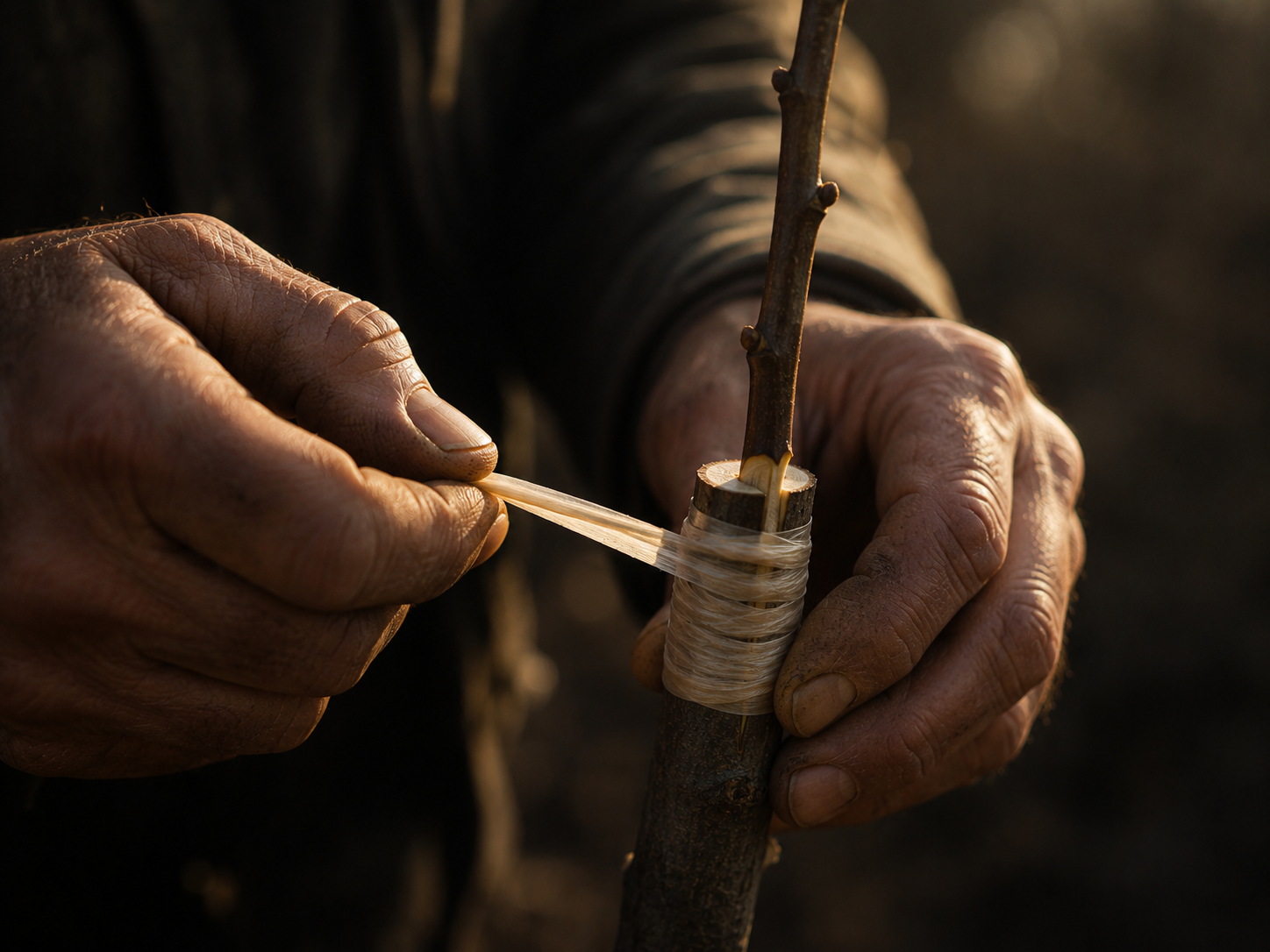
The graft only takes if both are wounded.
You slice into the scion, and you slice into the rootstock. The cambium has to be opened on both, that thin living layer just under the bark. And then the wet cut surfaces pressed together. If either one of them is left intact, then nothing happens. The branch dies on the ground.
The tree receiving the branch has to be opened up too.
And when it heals, the two wounds heal into one, a union line. You can see the ridge on the trunk for the life of that tree, right at the point where one thing became part of another.
You can't tell whose wound it was anymore.
Now let's go to a Sunday morning in a garden.
Mary Magdalene is standing outside the empty tomb, crying. She turns and sees a man and does not recognize Him. She reaches a conclusion about who He is.
"She, supposing Him to be the gardener, said to Him, 'Sir, if You have carried Him away, tell me where You have laid Him, and I will take Him away.'" (John 20:15, NKJV)
Several hours earlier this Man had been scourged with a Roman flagrum, crowned with thorns, and nailed to a cross. Isaiah said His visage was marred more than any man. He had been beaten past the point of looking human.
Mary looked at Him and thought: groundskeeper.
No one mistakes a man flayed to the bone two days prior as just being the help. The category her mind reached for was ordinary working man. Someone with dirt under his nails who might know where a body got moved.
Two men, on the road to Emmaus, do the same thing. Seven miles of walking. A long conversation about the Scriptures. A shared meal. And nobody flinches at how He looks.
The resurrection body is not carrying the damage. The beating is gone. The mockery is gone. The thorns left nothing behind.
Except...
"When He had said this, He showed them His hands and His side." (John 20:20, NKJV)
He showed them, He had to. They were not announcing themselves from across the room.
Thomas was not there, and when he refused the report, he asked for something specific. The print of the nails. The word is typos, the mark left by a blow, an imprint pressed into a surface.
A week later Jesus offered exactly that. Reach here. Put your finger here.
Hands. Feet. Side.
Those are not random injuries. Those are the points where He was fixed to the wood. The contact points.
And it doesn't end in that room. John sees Him again decades later, on the throne, and describes a Lamb "as it had been slain" (Revelation 5:6). The Greek is a perfect participle. The slaughter is finished and its condition stands. Standing, and still marked.
Of everything the crucifixion produced, the scar is the only thing carried into eternity.
He kept it.
Let's go back to Peter, because he tells us exactly what is wrong with the believer who isn't bearing anything.
"For he who lacks these things is shortsighted, even to blindness, and has forgotten that he was cleansed from his old sins." (2 Peter 1:9, NKJV)
Not laziness. Not weak commitment. Not a discipline problem.
Forgetting.
The barren believer is a grafted branch behaving like an ungrafted one. The root is still there. The union is still there. He has simply lost track of what was done to him, so he's back out on the end of the limb trying to manufacture his own sap.
And understand who is writing that sentence. Peter is not theorizing. He is the man who found out in a courtyard exactly what his own kratos was worth.
Read what Jesus told him before it happened. "But I have prayed for you, that your faith should not fail, and when you have returned to Me, strengthen your brethren" (Luke 22:32, NKJV).
When. Not if. The restoration was arranged before the failure occurred.
And then the moment itself. The rooster crows, and Luke gives us one line that should stop you cold: "And the Lord turned and looked at Peter."
No lecture. No correction. No method offered. He turned and He looked, and Peter went out and wept bitterly.
That's the whole transaction. The man who supplies to others got there through the failure, not around it.
So stop auditing your discipline. That was never the variable.
You cannot will your way into a nature. You can only remember the one you were handed, and then let it do what it does.
Go back to the point of the graft. Find the union line.
He still has His. He carried it out of the tomb, walked seven miles with it, held it out to a man who wouldn't believe without it, and He is wearing it on the throne right now.
That mark is the only reason you have any sap at all.
You have forgotten what it cost to attach you.
Go look at the scar.