God Knows the Difference
Every October, in pulpits across America, a pastor clears his throat and gives the annual warning:
Halloween is the devil's night. It's Satan's birthday. Witches are casting spells, the doors to the spirit world swing open, and your kids are walking straight through them with a pillowcase and a flashlight.
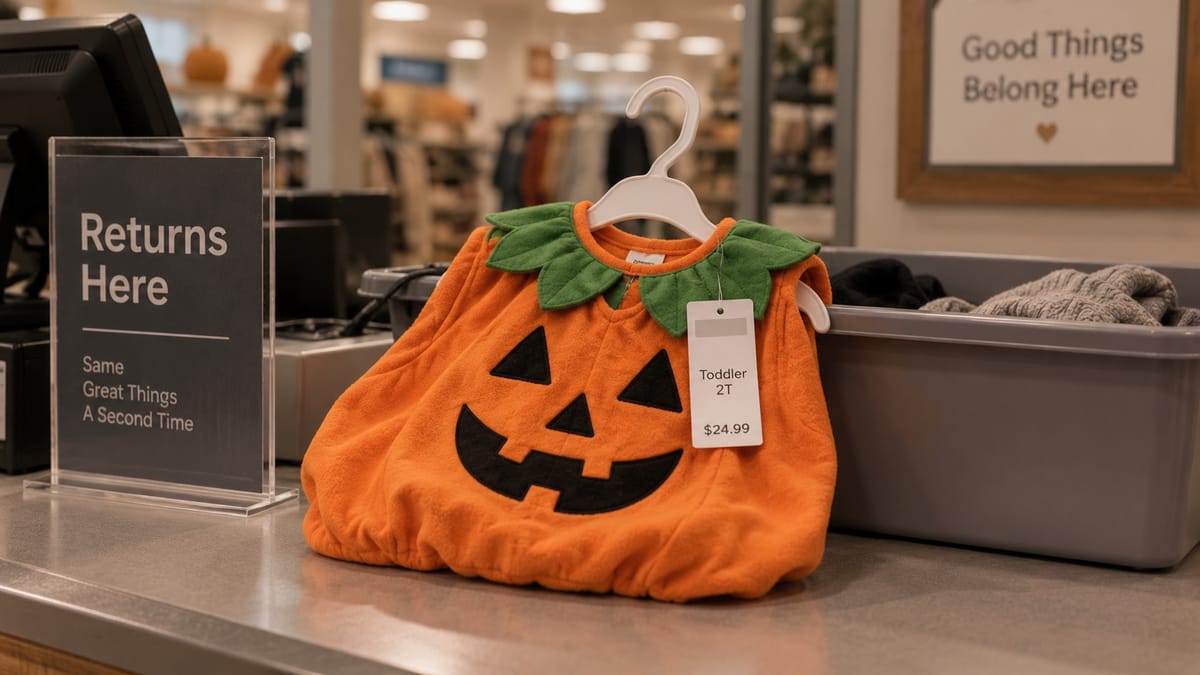
Some in the congregation nod. Some go home afraid. And somebody's mom takes the tiny pumpkin costume back to the store with the tags still on.
God knows the difference between a devil worshiper and your two-year-old in a pumpkin suit. The sermon forgets that, and it hands the devil a holiday he never owned.
Let's start with the name.
Halloween is a contraction of All Hallows' Eve, the night before All Saints' Day. A "hallow" is a holy one, a saint. It's the same root as "hallowed be Your name." The word itself came out of the church.
For centuries, the church used November 1 to remember the faithful who went before us, the "so great a cloud of witnesses" of Hebrews 12. The night before was the vigil, the eve. It belonged to All Saints the same way Christmas Eve belongs to Christmas.
The date has a real history. Christians were honoring the martyrs together as far back as the 4th century, on different days and in different places. In the 8th century, Pope Gregory III dedicated a chapel in St. Peter's to all the saints with a November 1 feast. By around 800, churches in England and Germany were already keeping All Saints on November 1. In 835, Gregory IV and the emperor Louis the Pious made it the standard across much of Europe.
You've likely heard the other version of this story, that the church picked the date to swallow Samhain, a Celtic festival of the dead.
Historians still argue about the details, but that story is a lot weaker than it sounds from the pulpit. The November date came out of English and German churches. The early Irish church, in the one place Samhain was actually kept, celebrated All Saints on April 20.
If Rome was trying to swallow Samhain, it forgot to tell Ireland.
And Samhain, the "Celtic god of death"? The Celtic sources never mention him. He shows up centuries later, and he's been showing up in October sermons ever since. The word actually translates to "summer's end" in old Irish, the end of harvest and beginning of winter.
The historian Ronald Hutton goes further. He says there's no real evidence Samhain was connected with the dead at all, and that the night picked up that reputation after a Christian festival about the dead landed on top of it.
So the haunted night the preacher warns about may have borrowed its ghosts from us.
When was the devil handed the deed? Rather recently.
In the mid-20th century, modern Wicca adopted Samhain as one of its festivals. In 1969, Anton LaVey published The Satanic Bible and listed Halloween as a holiday of the Church of Satan.
It ranked third.
LaVey wrote that the highest holiday in his religion is your own birthday, with Walpurgisnacht and Halloween following second and third.
If "Satanists celebrate it" is enough to forbid something, the birthday cake will need to go first, before the jack-o'-lantern. I'm still waiting on that sermon.
So here's the timeline. The church kept this night for over a thousand years. A man in San Francisco claimed it in 1969. And somewhere along the way, we decided he was the owner and we were the trespassers.
LaVey told a story about how he got started and I can't stop thinking about it.
He said that as a teenager he played organ at a carnival. On Saturday nights he watched men leer at the dancing girls. On Sunday mornings he played for tent evangelists at the other end of the lot, and watched those same men sitting in the pews with their wives, asking God to forgive them. And the next Saturday, they'd be back at the carnival.
He decided the church runs on hypocrisy.
We have to hold the story loosely. He never names the evangelist, the carnival, or the town. And LaVey's life story has been picked apart by journalists and even his own daughter, who found a good deal of it embellished or invented. It may be a sermon illustration he preached to himself.
True or not, the founder of the Church of Satan built his origin story out of what he saw in believers. What he needed from us was fear and inconsistency. The annual warning supplies both.
Paul already had this fight.
In Corinth, much of the meat in the market had passed through a pagan temple first. Some believers wouldn't touch it. Others ate it without a second thought. Paul had a response:
"We know that an idol is nothing in the world, and that there is no other God but one" (1 Corinthians 8:4).
And later, even more practically:
"Eat whatever is sold in the meat market, asking no questions for conscience' sake; for 'the earth is the LORD's, and all its fullness'" (1 Corinthians 10:25-26).
The earth is the Lord's. October included.
The Halloween preacher usually reaches for 10:20, where Paul says pagan sacrifices are offered to demons. He's right that the verse is there. But watch what Paul does with it. He warns them away from the table in the temple, the actual act of worship (10:21). Then four verses later, he sends them to the market with no questions asked.
A devil worshiper at a ritual is sitting at the table of demons. Your two-year-old on the sidewalk is shopping in the market. Paul knew the difference.
Paul does add a warning about the weaker brother, the believer whose conscience can't handle what yours can (8:9-13). Take it seriously. If your freedom would wound someone, lay it down for them.
Paul protects the weaker brother's conscience. He never hands it the gavel.
Romans 14 says it from both directions.
"Let not him who eats despise him who does not eat, and let not him who does not eat judge him who eats; for God has received him" (Romans 14:3).
The pastor who turns his own conviction into an annual verdict on every family in the building has skipped the back half of that verse.
Here's what bothers me most about the annual warning. It preaches the devil bigger than the cross.
"Having disarmed principalities and powers, He made a public spectacle of them, triumphing over them in it" (Colossians 2:15).
Jesus made a spectacle of the devil. The October sermon builds him a stage. Every year he gets a fresh round of credit he never earned: the power to claim a night, to own a date on the calendar, to slip into a child through a costume bought on clearance.
If a plastic pumpkin can open a door to the devil, you've given him more credit than the cross.
Now if you are one of those still afraid, I want to talk directly to you.
Your concern makes sense. You probably heard the warning every fall growing up, just like I did. Maybe you came out of something real, maybe an actual occult involvement, and October brings back things you'd rather forget. If that's you, your no is legitimate, and nobody gets to mock it or question it.
But you deserve to make this decision yourself, with your eyes wide open, instead of on the strength of a sermon that tried to scare you. Paul gave you the tools. And the first one, it turns out, is about days on the calendar.
"One person esteems one day above another; another esteems every day alike. Let each be fully convinced in his own mind" (Romans 14:5).
The decision is yours. Your pastor doesn't get to make it for you. Neither do I, and neither does the family down the street with the twelve-foot inflatable skeleton.
"For whatever is not from faith is sin" (Romans 14:23).
That verse protects you. If you can't take your kids trick-or-treating in faith, stay home. That's obedience, and nobody should shame you for it.
But the verse cuts the other way too. A no that comes from fear of the devil isn't faith either. The reason underneath your decision matters more than the decision.
So ask yourself a few honest questions: What's actually happening at this event? Is anyone being worshipped? Can I do this with a clear conscience before God? And, is my hesitation coming from the Holy Spirit, or from something I heard in a sermon?
Whatever you answer, remember who you are.
"You are of God, little children, and have overcome them, because He who is in you is greater than he who is in the world" (1 John 4:4).
"There is no fear in love; but perfect love casts out fear, because fear involves torment" (1 John 4:18).
Fear involves torment. God never asked you to carry it every October.
So turn the porch light on or turn it off. Hand out full-size candy bars or spend the night at the church harvest party. Carve the pumpkin or leave it in the field.
Just decide it as someone the devil can't touch. Because he can't.
And if a two-foot pumpkin rings your doorbell, give him the good candy. God knows the difference. Live like you do too.