They Said Jesus Had a Demon
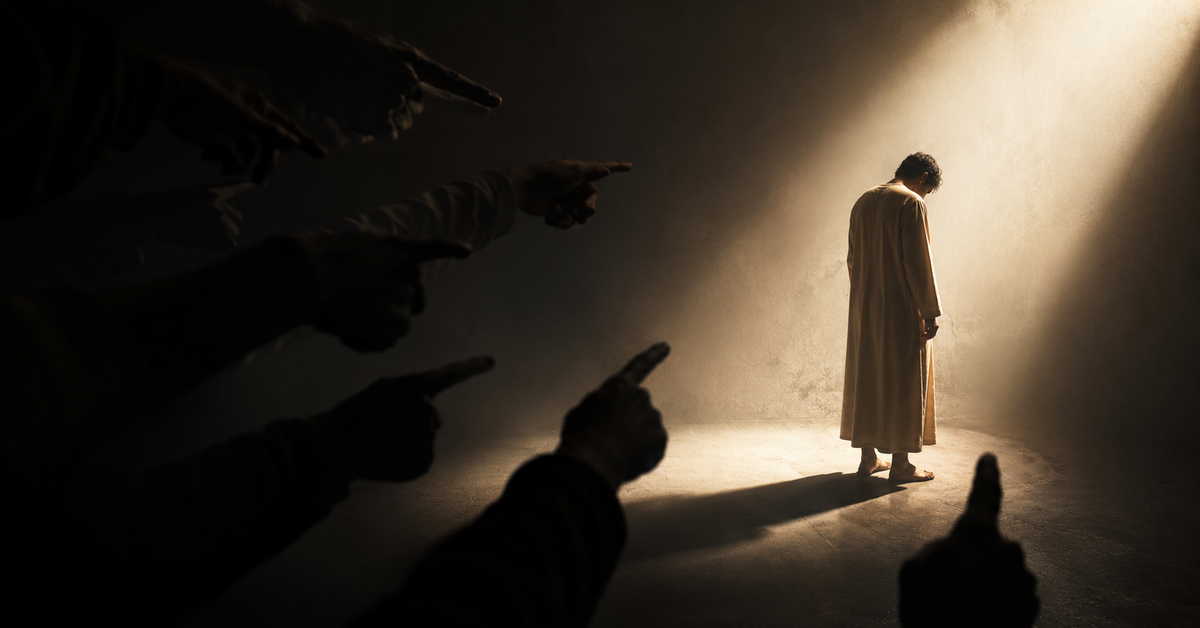
Scribes traveled down from Jerusalem and watched Jesus cast out demons. Then they delivered their diagnosis, which no one asked for: "He has an unclean spirit" (Mark 3:22, 30).
They looked at the most Spirit-filled Man who ever walked the earth, then called Him demonized.
His response gave us three things: Kingdom logic, the strong man, and the sternest warning He ever issued. We'll look at all three, but first we should understand why this matters.
There's a growing movement in the Church teaching that Christians can be demon-possessed. Deliverance sessions for believers. Conferences where the born-again line up to have their demons named and expelled. Believers trained to scan themselves for tenants.
As always, Scripture has an answer. And it begins with a word that was never in the text to begin with.
The word "possessed" appears nowhere in the Greek New Testament.
The word is daimonizomai. Properly translated, it means demonized. And alongside this word you find phrases like "having an unclean spirit." The King James translators reached for "possessed" and imported ownership language the Greek never carries.
This distinction matters, because ownership is the entire question. Possession is a property claim. And scripture settles the property question with the precision of a title office.
Work your way through the New Testament and watch where the demonized show up. The Gerasene man among the tombs. The synagogue man in Capernaum. Mary Magdalene before she followed Jesus. The slave girl in Philippi that Paul encountered.
Each of these cases sits outside of, or prior to, faith. After Pentecost, demonization in Acts appears out among the unevangelized. There are no instances of a Spirit-indwelt believer described as having a demon.
Believers receive different language. Satan sifts Peter like wheat (Luke 22:31). A messenger of Satan buffets Paul (2 Corinthians 12:7). The devil prowls like a lion, looking for someone to devour (1 Peter 5:8). He shoots fiery darts, and you are handed a shield (Ephesians 6:16).
All of this is war language. Kingdoms. Armor. Ground. And it consistently describes an army outside the walls. Not inside.
Paul even tells us where the contested ground exists. The strongholds of 2 Corinthians 10 are "arguments and every lofty opinion raised against the knowledge of God," demolished by taking "every thought captive." The battlefield in a believer is in your thinking. Ephesians 4:27 says give no topos to the devil. Topos: ground, a place, a foothold.
Ceded ground costs you range. Your walls hold, but the arrows land closer, the thoughts press harder, and the war gets fought in your courtyard instead of at your border.
Jesus ran the most demon-intensive training program in history.
He gave the twelve authority over unclean spirits and sent them out (Matthew 10:1). Then the seventy-two, who came back thrilled: "Lord, even the demons are subject to us in your name" (Luke 10:17). He corrected them on the spot: "Do not rejoice in this, that the spirits are subject to you, but rejoice that your names are written in heaven" (Luke 10:20). He only flagged one hazard, pride.
Then the mountain. Jesus comes down from the transfiguration to a desperate father and nine disciples who were unable to expel a demon from the man's son (Matthew 17). Watch where His energy goes. He dispatches the demon with a word and spends the rest of the scene on His disciples. "O faithless and perverse generation." The diagnosis is unbelief, and "this kind comes out only by prayer and fasting" aims at their doubt. The demon barely rates a mention.
Now weigh the silence.
Jesus gave His men a field manual. What to pack. Where to stay. When to shake the dust off their feet. What to say when arrested. He ran failure analysis when their attempt at expulsion went wrong. And He corrected them when their wins went to their heads. Look at every commissioning, every debrief, every post-mortem, never once did He issue a warning about the hazard the modern deliverance movement treats as a constant threat: the demon getting into them.
Send men into close contact with unclean spirits, mission after mission, and if infection were possible, the safety briefing writes itself. Jesus never gave it. Either He overlooked the danger, or the danger just doesn't exist for people under His authority.
Even the counter case proves the rule. The seven sons of Sceva invoked Jesus's name without belonging to Him, and the demonized man beat them bloody and drove them out naked (Acts 19:16). External assault, even for frauds. The demon overpowered seven bodies and entered none of them.
Look at Peter in Matthew 16.
Verse 17: "Flesh and blood has not revealed this to you, but my Father who is in heaven." Verse 23, same conversation, same man: "Get behind me, Satan."
Peter channeled both the Father and the enemy within the distance of six verses. Neither of them required anything living inside of him. And notice what Jesus did about it: He rebuked Peter and kept walking. No deliverance, no exorcism. There was nothing to cast out.
Influence rides on agreement, moment by moment. When Peter agreed with heaven, then heaven spoke through him. When he agreed with self-preservation, Satan found a mouthpiece. Neither of them controlled him, he spoke for the authority he stood in agreement with in that moment.
If Satan can borrow the mouth of the lead apostle without holding territory within him, the occupancy model has a problem.
I can already hear your objections, saying "sin already lives in you." Romans 7 says so. And if impurity can coexist with the Spirit, why couldn't a demon?
Because sin and possession are very different machinery.
The Greek word for sin, hamartia, is an archery term and means to miss the mark. The law drew the target, measured you, and the shot your flesh took went wide. But look at what missing the mark requires: an archer. A will, aiming. Sin is the active, conscious will of a functioning agent falling short of an exacting standard.
Possession is the surrender of the will itself. Look at the Gerasene man: crying out in another voice, unbindable, cutting himself with stones. His agency was overrun. Same with the boy at the bottom of the mountain, his father said the spirit threw him into the water and fire to kill him. Another spirit decided where each went, what they did, and how they behaved.
The Spirit sanctifies flawed material. He puts indwelling sin to death in you, progressively, sometimes painfully. But a demon is not a flaw awaiting sanctification. It is a rival claim on territory. And that is precisely the fellowship Paul rules out. "What accord has Christ with Belial? What agreement has the temple of God with idols?" (2 Corinthians 6:15-16).
Darkness does not mix with light. And light does not negotiate a lease for shared space.
1 Corinthians 6:19 gets quoted for the temple image, but the quote often cuts off before the receipt is read.
"Your body is a temple of the Holy Spirit within you, whom you have from God. You are not your own, for you were bought with a price."
Paul welds the temple to a purchase record. The title transferred at the cross. Ephesians 1:13-14 stacks on more legal language: you were sealed with the Spirit, who is the arrabon, the down payment guaranteeing the purchase completes. In the ancient world a seal marked ownership and protected the contents. Breaking one was a crime against the owner.
So let's look again at the deliverance claim, but now through the paperwork. For a demon to take possession of you, a title transfer has to occur. And your signature stopped being sufficient the day you were bought.
You can still shoot wide of the target. You can shoot wide badly, repeatedly, in ways that grieve the Spirit. You can give up ground, relinquish territory, and invite siege. That is just a performance failure within a settled ownership.
Selling the house requires the owner's signature. He is not selling.
Let's look again at Mark 3, because here we see Jesus answer the accusation with mechanics.
First, the kingdom logic: "if a kingdom is divided against itself, that kingdom cannot stand." Two opposing powers running one government is a structural absurdity.
Here's a modern picture. China, we know, operates within the United States every single day. Espionage, influence operations, cyber intrusions, bought voices. What China does not hold is a cabinet seat. Everyone instinctively knows the difference between activity within the borders and a share of the government. That difference is the difference between siege and possession.
Then Jesus explains how possession actually works: "No one can enter a strong man's house and plunder his goods, unless he first binds the strong man. Then indeed he may plunder his house" (Mark 3:27).
A demon holds a house by being the strongest thing in it. Eviction requires someone stronger, which is exactly what Jesus was. And why it required Jesus to grant authority to evict demons. And why the demons left screaming.
Now run that mechanism forward, past Pentecost. Your house now has a new, far stronger, occupant.
Now, follow that logic the rest of the way, because the deliverance movement stops before the bottom. For a demon to take possession of a believer, by the mechanics laid out by Jesus Himself, it would first have to bind the Holy Spirit.
That is the actual claim hiding inside "Christians can be demon-possessed." Say it out loud and it collapses. John already answered it: "Greater is he who is in you than he who is in the world" (1 John 4:4).
Let's look at one more detail from that scene that should sober everyone.
The accusation "he has an unclean spirit" is what triggered Jesus's warning about blaspheming the Holy Spirit. Mark says so explicitly: He warned them "because they were saying, 'He has an unclean spirit.'" (Mark 3:30). Attributing the Spirit's residence to the enemy is the error Jesus fenced off with the sternest warning He ever gave.
Now consider a movement that looks at born-again, Spirit-sealed believers, and as a routine practice diagnoses demons in them. I'm willing to grant every deliverance minister good intentions. But the ground their ministry stands on is the same ground Jesus put a fence around.
I hear the argument now: "But I've seen it happen."
Maybe you have. Something real occurs in those rooms. People shake. Voices change. Something leaves, and a person walks out lighter than they walked in.
But every one of those testimonies carries a hidden premise: that the person on the floor was born again to begin with. And that is the one fact no observer in the room can verify.
Scripture is blunt about the gap between the label and the birth. "They went out from us, but they were not of us, for if they had been of us, they would have continued with us" (1 John 2:19). Matthew 7 describes people who cast out demons in Jesus's name and still hear "I never knew you." Reciting a prayer in a desperate moment does not make a new creation. Romans 10:9 requires declaration and belief together, the mouth and the heart. Plenty of people carry the label for decades without the birth behind it.
A label is paperwork. New creation is birth.
So every "possessed Christian" story has to clear a bar it cannot see over: prove genuine transformation first. Either you watched a siege break, ground reclaimed, agreements shattered, and oppression lifted, or you watched a demon leave someone who wore the name without the nature. Both can happen. Neither puts a demon inside a temple.
The early church understood the order of operations. Hippolytus's Apostolic Tradition, written around 215 AD, records catechumens being exorcised daily in their final preparation, with a last exorcism by the bishop right before the water. Cleansing first. Then the sealing. They exorcised people on the way in because they did not expect to need it afterward.
Stop scanning yourself for tenants. That just trains you to doubt the purchase, which is the exact ground the enemy wants.
Instead, examine something far greater: "Examine yourselves, to see whether you are in the faith" (2 Corinthians 13:5). That is the real question, and it has teeth. Did you declare and believe? Or did you recite something in a desperate moment and carry a label ever since? One of those made you a temple. The other just makes you a member.
If you are in the faith, then fight the actual war you are in. Take thoughts captive, because arguments are the strongholds. Close the doors of agreement you've left open, because topos is real and you can hand over ground. Resist the devil, and read the promise attached: "he will flee from you" (James 4:7). Fleeing is what a besieging army does when the walls hold.
And the next time someone tells you a demon may be living in you alongside the Holy Spirit, ask them the strong man question.
Who could bind the Spirit?