The Only Thing that Burned
Shadrach, Meshach, and Abednego had already been promoted when the trouble started.
That's something we often overlook on the way to the furnace. Daniel 2:49 puts them over the affairs of the province of Babylon, three Hebrew exiles holding real authority in a foreign empire. You might think God had arranged that for a reason. Perhaps He did, or perhaps He just made use of the situation. Either way the goal was never comfort.
The king built a statue, a large, golden one. And he ordered the whole province to bow down and worship it. And everyone did as they were instructed, except our three young men. They remained obedient to God, and for that they were rewarded with accusation from jealous officials (Daniel 3:12), a furious monarch, and a death sentence. At the confrontation they answered the king directly and told him they refused to bow. And he ordered the furnace heated seven times hotter (3:19).
The temperature went up because they said no.
So the promotion cost them nothing and the obedience cost them everything, and the heat was measured against their faithfulness. Anybody who's been walking with God for any time at all has lived a version of that. You did exactly what He asked, and things got worse, and you couldn't find the part of the promise that covered this.
That's real. But that is just the doorway to this story, and most of us stop at the doorway. The text goes somewhere else, and I want us to follow where it goes.
Listen to what they said before their execution, because it governs everything after.
"Our God whom we serve is able to deliver us from the burning fiery furnace, and He will deliver us out of your hand, O king. But if not, let it be known to you, O king, that we do not serve your gods" (Daniel 3:17-18).
But if not. Three words that unhook their obedience from the outcome. They believed God could deliver them, and they said so. But they did not hang deliverance as a condition of their standing there. The decision was settled before the furnace door was ever opened, which means getting out alive was never why they refused to bow.
I keep coming back to that phrase because it's the thing that keeps the rest of this from turning into a motivational poster. Whatever the fire did for them, they didn't walk in to get it.
Now the inventory, because the text is unusually careful with it.
The strongest soldiers in the army bound them (3:20). They were tied up in their coats, their trousers, their turbans, and the rest of their clothing (3:21). So, they were fully dressed. And their restraints prevented them from walking into the furnace on their own. They had to be carried. And the fire had been made so hot it killed the men doing the carrying (3:22). The soldiers died on the outside of it while the three fell in, still bound (3:23).
Then the king looked in and was unable to reconcile what he was seeing. "Did we not cast three men bound into the fire?" His counselors confirmed it. "I see four men loose, walking in the midst of the fire" (3:24-25).
Loose. Walking. Two words the king never expected to use about men he thought he had just executed.
After they came out of the furnace, the writer takes stock (3:27). The fire had no power over their bodies. Not a hair singed. Their coats unchanged. They didn't even smell like smoke, which is a strange thing to record unless you're trying to be exhaustive. Hair, skin, clothing, even the odor. Everything they were tossed in with is checked off on the way out.
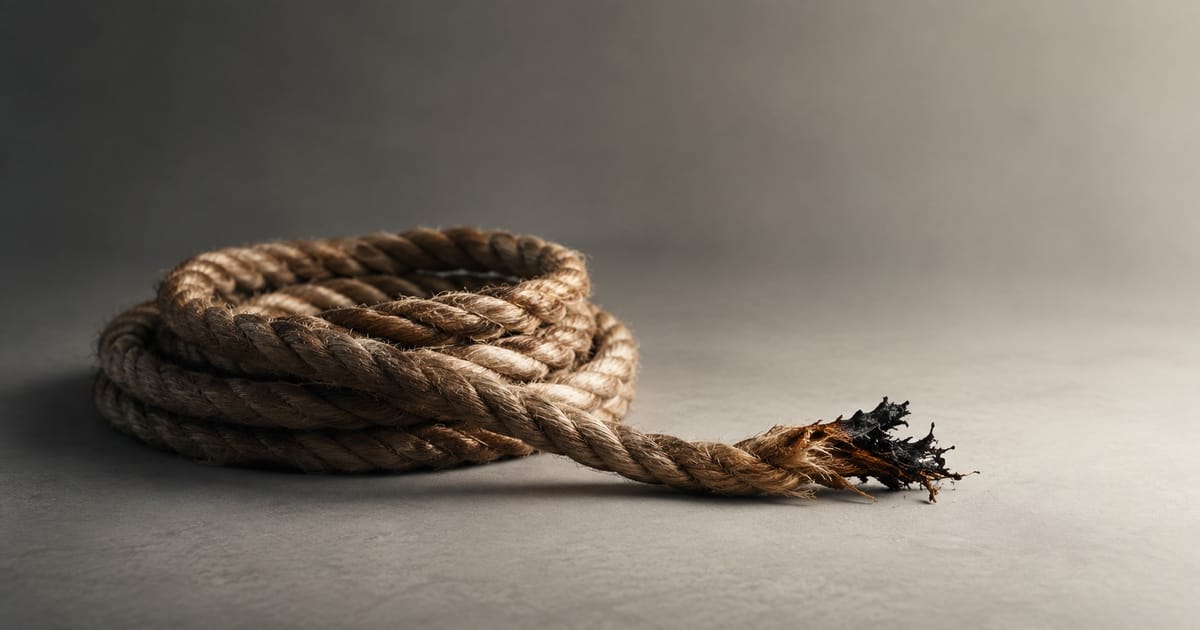
Everything except the ropes. The one item on the list that was tied on rather than grown or worn is the one item that didn't survive. Everything that was them came through intact. The only thing that burned was the thing holding them.
One fire, with two outcomes. The soldiers died near it and the three walked around in it, and the fire itself was identical. What each man carried toward it was the variable. The soldiers came in carrying the king's orders. While the three came in carrying orders from a different King. And carrying "but if not," on their lips.
I won't pretend the fourth man isn't in the story. He is, and every sermon on this passage goes there, and it should. But we've spent a lot of years on Who was in the furnace with them and almost none on what the furnace actually consumed, and I think the second question has more to say than we've let it.
The fire consumed the restraints.
Nothing else.
Here's the part I'll own as a stretch, because the text records it without preaching it.
The three didn't tie themselves up. The king's men did (3:20). The same system that demanded they bow is the system that bound them when they wouldn't, and the restraint came from outside, applied by people who needed their compliance and got their refusal instead.
That matters when you start asking what's actually holding you. Some of it you picked up yourself, and you know which parts those are. But some of it was tied on by people who wanted you to kneel and they didn't like it when you stayed standing. A church that needs you quieter. A family that needs you smaller. A role that only worked if you didn't ask certain questions. Either way, it's on you now, and it's the reason you can't move your arms.
So let me ask the question we've been walking toward.
What have you been praying for God to put out?
I know the prayer. I've prayed it. God, cool this down. God, get me out of this. God, I did what You said and now everything is on fire, so make it stop. It's an honest prayer and I'm not going to shame anybody for it.
But somewhere in the middle of that prayer, I think we've picked up an assumption that the text won't support, which is that obedience should produce relief. That if I do the right thing, the ground under me should firm up.
But the whole witness of Scripture runs the other direction. Obedience leads to refining long before it leads to anything that feels like relief.
Malachi says God sits as a refiner and purifier of silver (Malachi 3:3). Zechariah says He'll refine His people as silver is refined (Zechariah 13:9). Proverbs says take away the dross, and a vessel comes out (Proverbs 25:4). Psalms says, “The words of the Lord are pure words, like silver tried in a furnace of earth, purified seven times (Psalm 12:6).
None of those are gentle images. A refiner doesn't warm the silver. He heats it past the point where it can hold its shape, and he keeps it there, because that's the only temperature at which the impurities let go of the metal and rise to the surface where they can be skimmed off. What's left is silver, with nothing added, and everything foreign removed.
The silver never asked for that. It also wouldn't be pure silver without it.
Which means the fire you keep asking God to extinguish may be the only thing in your situation that has ever touched the ropes. Nebuchadnezzar, with all his power and influence, could not reach into that fire and untie them. The soldiers who watched their fellow soldiers die tossing them in were not going to help. The three couldn't reach their own knots.
The promotion they received back in chapter two didn't loosen a single cord.
The fire did.
If that's what's happening, then you've been praying to keep your bindings. You just didn't call them bindings. You called them stability, or reputation, or the relationship, or the version of yourself that everybody was comfortable with. You called them dross, if you were being honest, and you probably asked God to leave the dross alone.
The trial is still a trial. I'm just telling you its purpose.
The soldiers who died had nothing in them that could survive that heat. The three had nothing in them that could burn. What they had on them, the stuff tied from the outside, went up in seconds and nobody mourned it.
You will not come out of this smelling like smoke. You might come out with less on you than you went in with, but that need not be counted as a loss. That is the silver, which Scripture uses to represent righteousness.
The king promoted them afterward, higher than even before (3:30). But if you make that the point you will miss the whole thing. They didn't obey for the promotion the first time, and they didn't obey for it the second time.
They obeyed.
They said, "but if not," fell in tied up, and walked out free. The promotion was Babylon's business. The ropes were God's.
Stop negotiating the temperature.
Stop asking God to make it seven times cooler when He's the one who let them turn it up.
Walk in bound if you have to, but for sure walk in with "but if not" on your lips and with no rescue guaranteed. And when you get to the middle of it and realize you can move your arms, don't run for the door.
Walk around a while. And meet the Son of God who walks in there with you.
Allow it to finish its work. Let the dross rise to the top.
"The only thing that burned was the thing holding them."