And the Church Didn't Say Amen
The accusation arrives the same way every time. The church has become too political. Pastors need to stay in their lane. Keep religion out of public life.
It sounds reasonable on the surface. It is also exactly backwards.
The Church did not move into the political sphere, politics invaded the Church. We did not become political, we were here the entire time.
Politics forced its way in and demanded a response.
The Sleight of Hand
Here’s how the move works.
The state identifies a moral question the Church has been answering for two thousand years. Then it rebrands the question from moral to political and issues its own ruling on the matter. Now it has been repackaged as policy.
And then the state tells the pastors they can’t speak on the matter because it is political.
The reclassification is the weapon. It attempts to silence the Church on the very question being decided, while the decision is being made anyway. By the time the pastor figures out what happened, the answer has been written into the public conscience. Then his protests sound like nothing but partisan noise.
And an entire party, because they agree with the opposite position, can be written off as harmful because they side with religion and not public policy.
This is not accidental. Reclassifying theology as politics is how you neutralize it without having to refute it. You do not have to argue against the Church’s position on abortion if you can rule the Church out of bounds for having one.
Suddenly policy has supplanted what the Church has been declaring.
The Examples
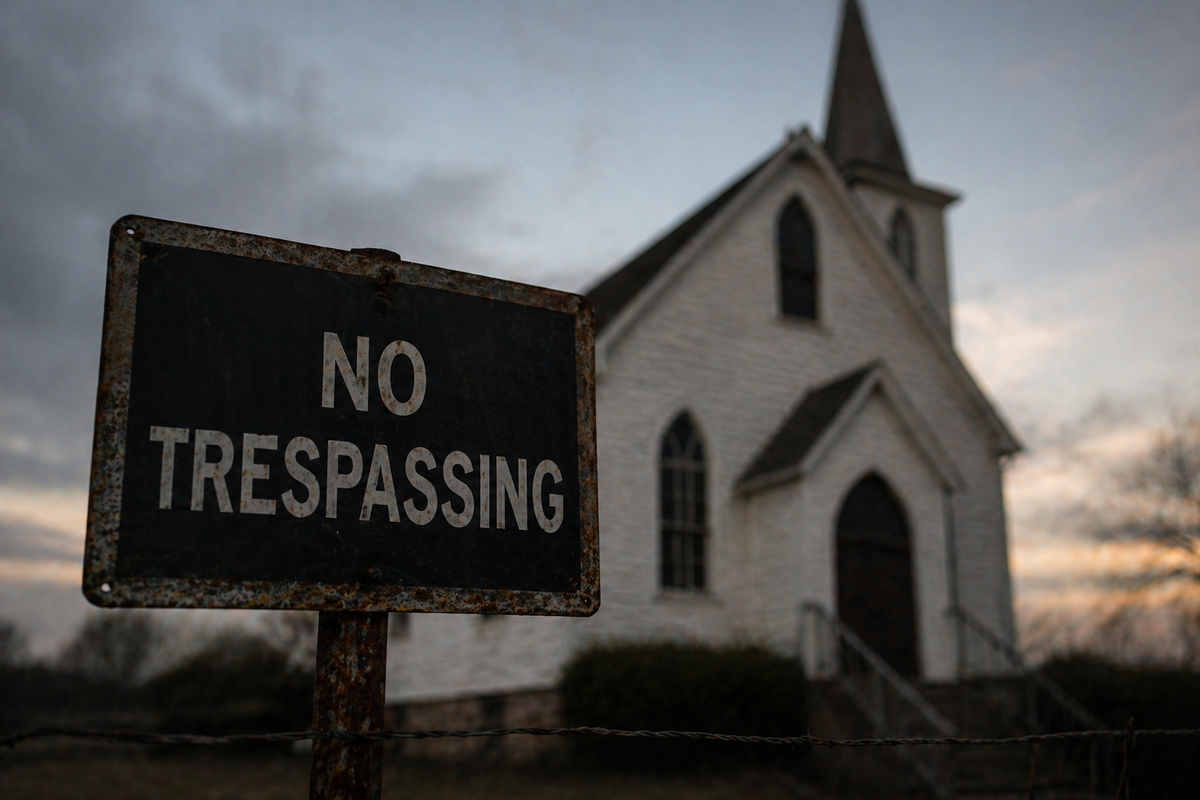
Abortion is the cleanest case. The church has spoken about the unborn since the Didache, a teaching document used by the first-century church. It was never political. It was anthropological and moral. Roe v. Wade did not ask the church to enter politics. It moved a question the church had answered since its first century into the political arena, then accused the church of trespassing when it kept offering its answer.
Gender is the same move at a deeper level. Genesis 1:27 is the church’s territory by definition. What it means to be male and female. What the body is for. What marriage is. The church did not pick this fight. The categories were rewritten in the surrounding culture and the church was told its existing answers were now political positions.
The redefinition of holiness, this is the deepest one. It is the engine of the other two, and many others. When culture redefines what is sacred, what is profane, what is worthy of reverence, what counts as blasphemy, it is claiming the church’s foundational vocabulary.
And the church gets called political for objecting.
The church did not move. The ground moved. Calling the church political for standing still is the trick that lets the annexation happen quietly.
Two Corruptions, Not One
The church can be corrupted by political alignment. That corruption is real, and it is everywhere. A pastor whose vote can be bought by a public entity is not exercising his prophetic voice. He is selling it.
Pulpits that turn into campaign assets have already lost the Gospel they claim to preach. The campaign flag on the platform. The candidate in the green room. The endorsement traded for influence. Every one of those moves trades prophetic voice for proximity to power.
And every time, the church loses.
But that is a different corruption from what we’re discussing. The pastor who refuses to call abortion evil because it is “political” is not avoiding corruption. He is accepting a different one; the corruption where the state defines the church’s vocabulary.
Both betray the church. The first by removing its voice. The second by selling it.
The faithful position is a voice that cannot be bought and cannot be silenced.
Equal Voice, Not Equal Truth
Here is the part that will challenge some Christians. If the public square is genuinely public, then everyone with a worldview gets to speak into it.
Including the worldviews we believe to be false.
Islam gets a voice. The LGBTQ+ movement gets a voice. Secular progressivism gets a voice. And, the church gets a voice. None of them get a privileged microphone. Each one shows up, makes their case, and the people decide which one they want to represent them.
Before you come for me with your pitchforks, this is not the ‘coexist’ bumper sticker. That sticker says all paths are equal and none of them matter enough to argue about. I disagree wholeheartedly with that sentiment. I believe the Gospel to be true and the alternatives to be false. I desire the Gospel to win.
But I do not need the state to silence the other voices for that to happen. I need the square open. I need my voice in it. And I need the confidence that the God of the Gospel is able to take care of Himself.
A lot of Christians will not accept this. They want the church’s voice restored and they want the competing voices ruled out of bounds. That is not faith. It is the same annexation move, but running in the opposite direction.
If we get a voice, they get a voice. And theirs is not superior to ours.
But here is what cannot be lost in all this. Allowing other voices does not mean muting our own. In fact knowing we both have a voice should embolden us to use ours. Equal voice cuts both ways. If they get to argue their case, we get to argue ours. And our case includes calling evil for what it is, evil.
The church does not get to speak only when it is affirming. Prophetic voice is not prophetic if it can only bless. Jesus called Herod a fox. Paul named names. John the Baptist lost his head for telling a king his behavior was sinful.
None of that was polite coexistence. None of it was silencing the other side either. It was speaking the truth in the same square where everyone else was speaking, and accepting the cost of doing so.
Confrontation is not the opposite of equal voice. Silence is.
The Question Underneath
Here is the line everything else has been pointing toward.
The Gospel does not need us to tilt the scale in its favor if the God of the Gospel is truly the God we say He is.
That conditional is the whole argument. If God is who we say He is, tilting the scale is disingenuous. If tilting the scale feels necessary, somewhere underneath the activism is a quiet doubt about God Himself.
The pastor who needs his vote to be worth buying does not trust God to fund His ministry. The Christian who needs Islam silenced does not trust God to outshine it. The movement that needs the rules tilted does not trust God to win on level ground.
Every form of religious power-seeking is, underneath, a confession of theological doubt.
The church does not need protection from the marketplace of ideas. It needs to be allowed in. And then it needs to actually believe what it claims to believe.
That is the posture politics cannot annex. A voice that speaks because it must, refuses to be bought, and trusts the God it preaches to handle the outcome. Like Elijah on Mt. Carmel, let the God who answers by fire be God.
We do not need the public square to see us as equal before we treat them that way. We present the God of the Gospel we know to be true and we let Him reveal Himself.
We were here first. We still are.
We don’t need to ask permission. We need to speak.